
Male Pattern Baldness
Androgenetic alopecia (AGA), also known as male pattern baldness, is one of the most common conditions affecting men. In the United States alone there are over 35 million men are affected by AGA.
Recession of the temporal area is typically the first place of hair loss; in some men the loss stops there and never progresses while in others it can continue into other areas of the scalp. Progression can vary being rapid in some men and slower in others.
No matter how severe the hair loss, hair is not lost at the back or sides of the head. These regions are genetically different from hair follicles found in the front and top of the head. The hair at the back and sides of the head can be harvested and transplanted to bald or thinning areas and continue to grow as they would on the side and back of the head.
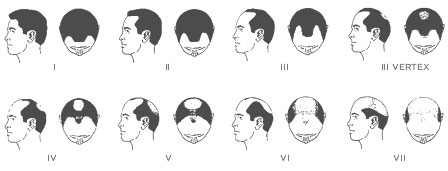
The Norwood Classification Chart will give you an idea about what stage of hair loss you may have. The chart is the standard classification for the most common types of male pattern baldness. Although it is useful to determine what stage of baldness you approximate, most patients will not fit perfectly into any category, nor are stages necessarily progressive for each patient.
NORWOOD CLASSIFICATION CHART FOR MALE PATTERN BALDNESS

TYPE III
Represents the minimal extent of hair loss considered sufficient to represent baldness. Scalps have deep frontal temporal recessions, which are usually symmetrical and are either bare or sparsely covered.
Patient example Type III Baldness »
TYPE III VERTEX
Hair loss is chiefly in the vertex. There may be some frontal recession, but does not exceed that seen in Type III. This type of baldness is most common with advancing age, but, in some patients, may occur early and occasionally precede significant front loss.
Patient example Type III Vertex Baldness »
TYPE IV
The frontal and temporal recession is more severe. There is a sparseness or absence of hair on the vertex area. These areas are extensive, but are separated from each other by a bridge of moderately dense hair. Should not be confused with Type III Vertex in which the loss is primarily on the vertex.
Patient example Type IV Baldness »
TYPE V
The vertex region of alopecia remains separated from the frontal temporal region of alopecia. The separation is now not as distinct because the band of hair across the midscalp has become narrower and sparser. Both the vertex and frontal temporal areas of alopecia have become larger.
Patient example Type V Baldness »
TYPE VI
The bridge of the hair that crossed the midscalp in the previous type is now gone. The frontal temporal and vertex regions of alopecia have become confluent; in addition, the entire area of alopecia has increased laterally and posteriorly.
Patient example Type VI Baldness »
TYPE VII
This is the most severe form of male pattern baldness. All that remains is a narrow horseshoe shaped band of hair that begins laterally just anterior to the ear and extends posteriorly on the sides. This hair is usually not dense and is frequently fine.
Patient example Type VII Baldness »
Most Popular Pages
Most Viewed Patients
Info About IHSG
Can't Find the Answer?
Email IHSG your specific question
Our surgical technicians and staff are available to help you find the hair loss solution that works for you and answer any questions you have regarding hair restoration and hair transplantation surgery.
FINANCING YOUR PROCEDURE
100% FinancingNo Interest Payment Plan
No interest for 3 months if the balance is paid in full within No Interest period, with no prepayment penalties... MORE